
Quick answer (from a practicing physical therapist): Plantar fasciitis is the most common cause of heel pain, and it is fundamentally a load problem — the tissue hurts because it is being asked to do more than it can currently tolerate, not simply because it is inflamed. Most cases resolve without injections or surgery. The classic sign is sharp heel pain with your first steps in the morning that eases as you move. What actually works is controlled loading — calf and plantar fascia strengthening, supportive footwear with genuine arch support, and activity modification — not complete rest, which calms pain short term but leaves the tissue weaker. Most people improve meaningfully in 6 to 12 weeks of consistent work; stubborn cases can take 6 to 12 months, which is normal. See a clinician if pain wakes you at night, you notice numbness or tingling, or nothing changes after six consistent weeks.
As an Amazon Associate. We get small commissions for purchases made through affiliate links in this post at no extra cost to you. More info. Amazon Affiliate Disclaimer
The Bottom Line — From a Practicing Physical Therapist
- Plantar fasciitis is a load problem, not simply an inflammation problem. The tissue hurts because it is being asked to do more than it can currently tolerate.
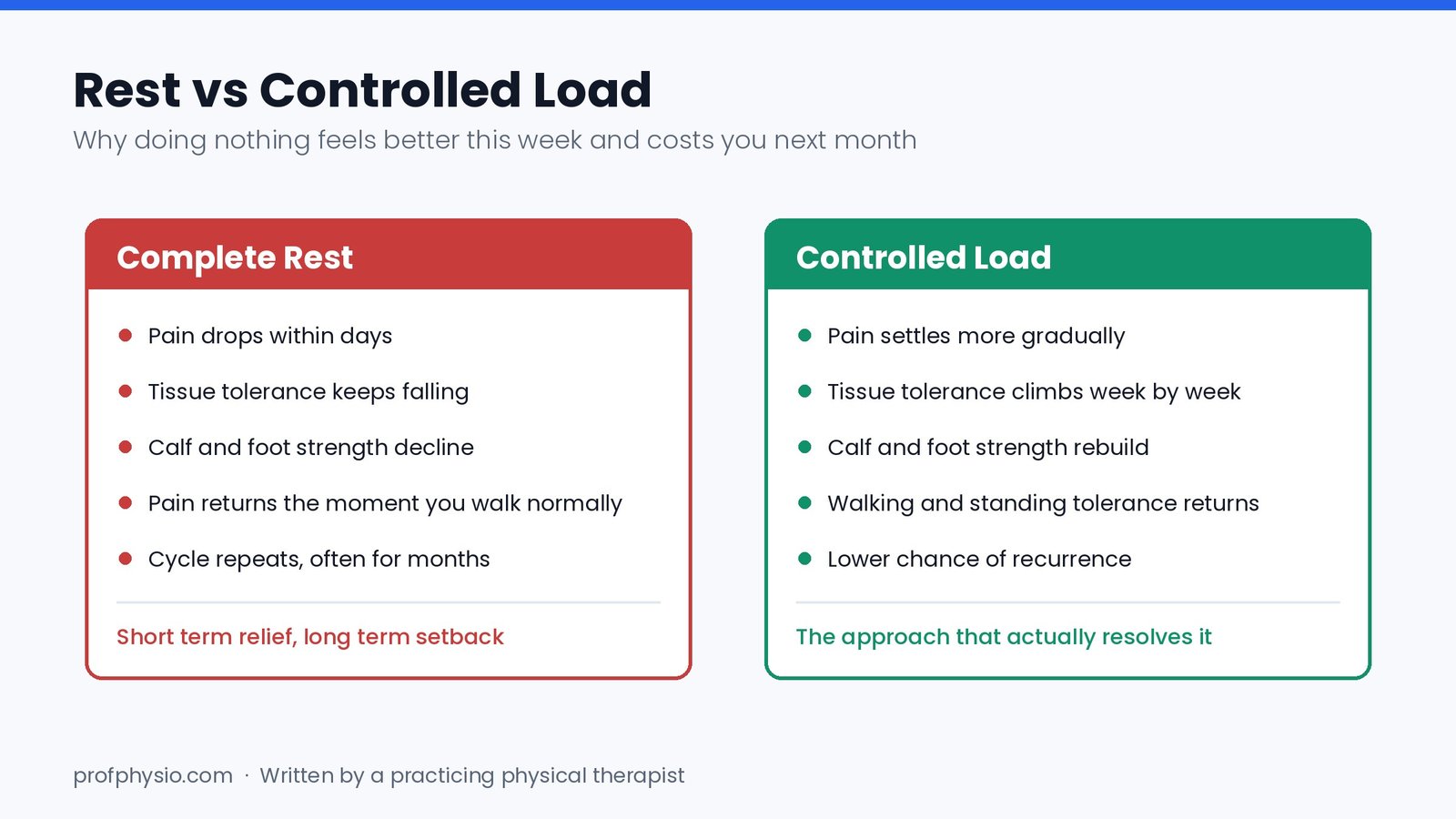
- Complete rest is the most common mistake. It calms the pain short term and leaves the tissue weaker long term. Controlled loading beats doing nothing.
- What actually moves the needle: calf and plantar fascia loading, footwear with genuine arch support, activity modification, and consistency.
- Realistic timeline: most people improve meaningfully in 6 to 12 weeks of consistent work. Stubborn cases can take 6 to 12 months. That is normal, not failure.
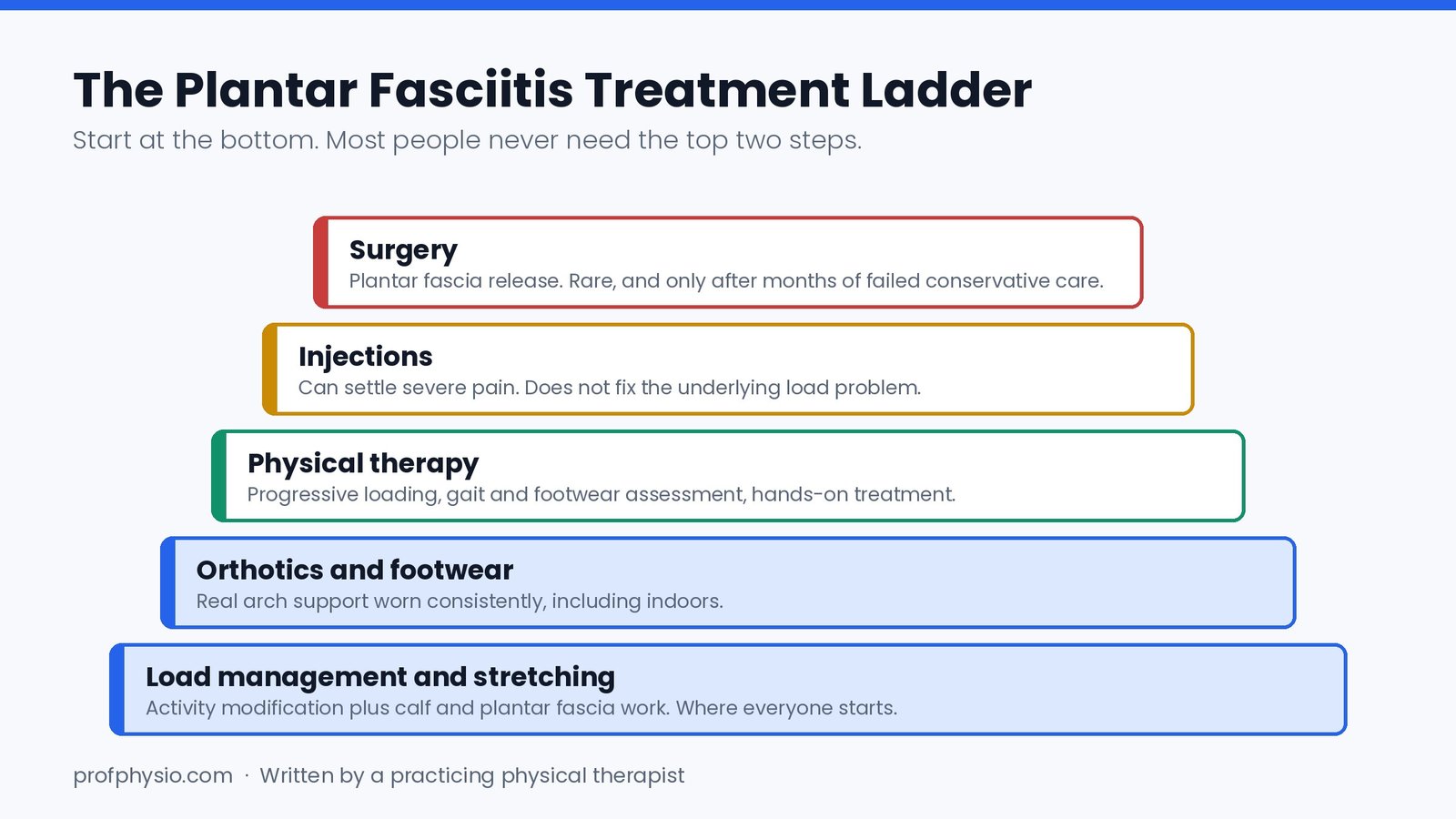
- Injections and surgery sit at the end of the ladder. The large majority of people never need either one.
- See a clinician if the pain wakes you at night, you notice numbness or tingling, or nothing has changed after six consistent weeks.
Plantar Fasciitis: A Physical Therapist's Complete Guide
Do you suffer from pain in one of both feet, specifically in the heel area
Does this pain seriously hinder your movement and daily activities?
Have you ever been diagnosed with Plantar fasciitis in your life?
Do you want to know all aspects of Planter fasciitis, and how do you deal with your condition?
Plantar fasciitis is a condition affecting your foot bottom surface, which is in contact with the ground named as the dorsal aspect of your foot. This condition results in swelling in your foot, making it difficult for you even to walk and many more.
In this article we will talk about all aspects of this disease, what it is, what leads to this condition, what typical symptoms are you experiencing, how this disease can be accurately diagnosed and what are the risk factors for your concern and what can you do prevent this disease that is affecting your life and diagnosis of plantar fasciitis. This diagnosis will be made to exclude all the risk factors associated with illness and the main reasons that may exacerbate the problem and increase the disease progression.
The best treatment is provided in this article to obtain the best results and to make the most excellent improvement. As it is possible for you to take precautionary measures and to avoid as much as possible the option of surgery.
What Is Plantar Fasciitis?
As described earlier, Plantar fasciitis is that condition causes pain in the bottom of the foot (plantar fascia). It is the most common injury of the plantar fascia and mainly responsible for about 80% of heel pain cases. It affects approximately 7-10% of the population. This pain increases after the irritation of that flat band (Plantar fascia), which connects the heel with the toes in the plantar aspect of the foot.
According to body biomechanics, the function of that flat band (plantar fascia) is to protect the underlining soft tissues like foot plantar muscles, vessels, and nerves, and to maintain the shape of the natural archs at the bottom of the foot. The function of these archs is shock absorption and distribution of equal pressure to preserve the balance of the body during the movements of natural standing, walking as well as doing various activities of healthy life from sports like running, jogging, dancing, jumping and other compound movements
With aging, especially for those aged 40 to 60 years, changes occur in the Plantar fascia. Thus, these changes will result in the weakening of the tissue and increased susceptibility to irritation and injury. Especially when there is the availability of risk factors that increase the chance of irritation. These risk factors will be later discussed in this article.
Stress that irritates plantar fascia increases with repetitive movements of the feet and ankle, for instance, during running. Over time, micro-tears of the plantar fascia may happen. These stress factors are overload and strain involved in irritation of plantar fascia. This condition can even occur in younger patients that moving or playing sports in a wrong manner leading to overloads on the tissues or vigorous workouts.
While overload and stress on plantar fascia increase with the time and assuming that it occurs daily, tightness and shortening increase because of the physical adaptation of plantar fascia and with doing various movements that may cause microscopic tears of the plantar fascia.
Over time, these micro-tears will cause inflammation and pain in the plantar fascia. That resulting inflammation stimulates the accumulated cell growth, which will produce the scar tissue in plantar fascia later on. This newly formed scar tissue will cause more tightness, irritation, and pain. All of these symptoms will form a closed circle resulting in plantar fasciitis.
What Causes Plantar Fasciitis?
In general, if there’s an over-pressure due to some physical causes on the plantar fascia that will make plantar fascia to be overloaded, irritated, and inflamed, resulting in the condition named plantar fasciitis.
The most common causes that increase stress on the plantar fascia are:
- Overweight. Especially sudden weight gain.
- Prolonged standing. Even you have a thin body, the effect of gravity will affect you. There are the following examples of occupations which involve standing for an extended period: these occupations are employee at factory, dentistry, airport security, and teaching profession.
- Excessive or vigorous workouts. Especially on hard surfaces like walking and running for long periods, which may increase the chance to overstretch the plantar fascia.
- Unsuitable shoes. The shoes which are not well fitted or not supporting the foot archs especially the medial arch will result in overload on the plantar fascia. The most frequent shoes that make an overload on the plantar fascia is the high heel shoes and shoes with poor cushioning.
- Tight calf muscles and Achilles tendon.Due to the lake of warming up before exercising like walking and running.
- Foot deformities. Like, moderate to severe high medial arch or flat foot, making an overpressure on plantar fascia due to abnormal body biomechanics.
- Pregnancy. Due to weight gain usually late in the last trimester of pregnancy.
Plantar Fasciitis Symptoms: Signs You Should Not Ignore
Plantar fasciitis symptoms may worsen gradually with time. The most common symptoms of plantar fasciitis are dull or sharp aching pain and tenderness of the heel. Sometimes the pain can be felt on the whole sole of the foot.
In 70% of plantar fasciitis cases, it will be unilateral (meaning affecting only on one foot). If you develop some pressure in your thumb on some points in your heel and sole of the foot, you will experience a sharp tenderness in some of these focal points, which are called (Trigger points).
The maximum pain will rise when you wake up meaning in the early morning just after a few steps of walking, or during weight-bearing after prolonged periods of rest or sitting. But also, sometimes pain increases after prolonged workouts when you take a rest (but not during exercising) or when you stand for several hours.
As you will notice, more pain will occur when you raise your toes upward during standing (toes in hyperextension position) or during ascending stairs. However, radiation of pain to the other joints is rare.
The second most common symptom of plantar fasciitis after the pain is the tightness of plantar fascia and the foot muscles in the bottom of your foot. If plantar fasciitis didn’t treat for a long time, tightness might develop, leading to the stiffness of plantar fascia and the foot.
Most cases of plantar fasciitis cases suffer from tight calf muscles; this is due to the nature of the body mechanics and their effect on each other and the motor coordination between the muscles of the foot covering the bottom of the foot with the calf muscles.
Similarly, some patients reported rare symptoms like burning, numbness, tingling, referred pain. If plantar fasciitis didn’t treat for a long time (several years) patient may experience rupture of the plantar fascia, and that may develop symptoms of clicking, snapping sounds, and local swelling. All these symptoms mentioned above will cause acute pain to grow in the plantar aspect of the foot.
Who Gets Plantar Fasciitis? Risk Factors That Matter
Many factors can increase the risk of developing plantar fasciitis. Some of these factors are not under your control. Still, some of the factors you can modify to maintain the normal pressure of body weight on the sole of the foot and to reduce the overload, which may cause plantar fasciitis. These risk factors include:
- Age. The age group which is most commonly affected by plantar fasciitis is between 40-70.
- Overweight. Any extra pounds can make an overload on the plantar fascia, especially if you are standing for long periods, which can make the impact of gravity more on the plantar fascia and resulting in more stress. That impact can speed up the tear and wear mechanism faster during different daily activities, causing plantar fasciitis. Obesity is seen in 70% of plantar fasciitis cases. So, you don’t have to be one of them.
- Certain occupations. Occupations that need a standing or walking for prolonged periods like teaching, Security men, or factory workers, …etc. That can damage plantar fascia, especially with the availability of previous risk factors.
- Individual sports and vigorous exercising. Sports, like running for long distances, ballet dancing, or exercising vigorously, especially with that repetitive high impact movements, can make stress on the plantar fascia.
- Biomechanics of ankle joint and foot. If you have a flat foot or any abnormal pattern of movement of your foot or ankle during standing or walking, or even your foot is highly arched like in pes cavus deformity, then you’re prone to suffer from plantar fasciitis.
- Inappropriate footwear. Wearing high heel shoes, especially for prolonged periods, can increase the tightness of Achilles tendon, and that will disturb the biomechanics in between Achilles tendon and plantar fascia resulting in more stress.
- Leg length discrepancy. If you have a leg length inequality congenitally or due to a previous surgery like for instance Total hip replacement (THR) or an internal fixation surgery for a comminuted fracture or something like that, then you have to ask your doctor or physical therapist which type of insole or shoe raise you can use to compensate for the lack of leg height.
How Is Plantar Fasciitis Diagnosed?
To diagnose plantar fasciitis, your doctor will ask you some questions about your health history if you have any disease or history of injury, which may cause your symptoms.
Then your doctor will inspect your feet and ankle joints during standing and walking for any abnormality like flat foot, pes cavus (high arched foot), or tight Achilles tendon.
If your doctor thinks that you may have plantar fasciitis, he will make a physical examination for your feet. When the doctor do a physical exam, he will ask for the following questions. These questions can be to raise your toes toward your chin (toes extension), as he will ask you to flex your ankle while he resists you. If you feel some pain, then this may be a sign of plantar fasciitis.
Another physical examination will include applying pressure by the doctor thumb on foot to identify the points of pain in the plantar fascia (tenderness points)
If the physical exam doesn’t conclude that you are suffering from plantar fasciitis, then your doctor will suggest you do an X-ray or Magnetic Resonance Imaging (MRI) for more investigations and to rule out any other condition or diseases like a stress fracture, neuropathies, osteoarthritis or bursitis.
In some cases, pain referred to the foot or ankle from the lower back may be due to lumbar disc, spinal stenosis, or any condition causing compression on nerve roots of lumbar or sacral spinal levels L5 or S1. In that case, your doctor needs to do that medical imaging tests to make a differential diagnosis.
Sometimes, Calcaneal bone of the heel of the affected foot can become calcified, this condition is called (heel spur). In such cases, the pain is not due to the heel spur itself but can be to the plantar fasciitis.
What Happens If Plantar Fasciitis Goes Untreated?
Pain that results from plantar fasciitis can disturb you while doing your daily activity living from waking up and getting out of the bed to standing and walking during the day until sleeping at night.
When you are doing various types of activities during these tasks, your feet lift the whole weight of your body because it is the base of your body. So, any deviations or faulty movements in your feet result from the pain of plantar fasciitis, which will affect your knees, hips, pelvis, and lower back standard mechanics. In case, you have to correct these deviations or faulty movements of your feet to prevent any impact on your knees, hips, and back.
If plantar fasciitis doesn’t treat for a long time, it may cause a significant effect on your knee and hip joints like causing osteoarthritis, and that may result in the false pelvis and lower back movements causing low back pain.
In some rare cases, when plantar fasciitis is not treated or any other similar chronic foot conditions arise, this may result in long-term problems, not only to the knee, hip, or back pain but even may that can lead to neck pain.
Plantar Fasciitis Treatment: What Actually Works
When your doctor diagnose that you have plantar fasciitis, he will apply treatment in a specific sequence of conservative methods.
However, in most of cases, about 90% of plantar fasciitis cases improve within 6 months up to one year with help of conservative treatments. Your doctor or physiotherapist will start by observing your lifestyle to make any possible modifications to give you the best chance of treatment and to gain the best improvement result. This treatment sequence includes:
Home Remedies and Lifestyle Changes for Plantar Fasciitis
Your doctor or physiotherapist will give you some instructions that will help you to relieve the pain of plantar fasciitis and will prevent more stress and inflammation of the plantar fascia. As well as these instructions, you will get medical treatment and will get the best result of improvement until you are cured. These instructions and home remedies include:
- Take a rest and try to modify any activity that applies more stress or overload on your feet, like in standing, walking for prolonged periods. Even that is the nature of your occupation, you have to try taking some short breaks every 30 minutes, to decrease stress as much as possible and let your muscles relax from time to time.
- Avoid walking with bare feet on hard surfaces.
- Avoid any vigorous exercising like running or stretching (overstretch) that may cause micro-tears of the plantar fascia and result in plantar fasciitis.
- Do good warm-ups before engaging in any type of sports and concentrate on warm-ups for both Calf muscles and Achilles tendons. Do good but gradual stretching.
- If you have pain and swelling, your doctor will advise you to apply home remedies like RICE principle:
R Rest.
Take a rest from any activity that continues more than 30 minutes.
I Ice.
Apply Ice for 10-15 minutes to numb pain and decrease inflammation.
C Compression.
Coinciding with the Ice applies compression by using medical socks to decrease swelling and improving blood circulation in the foot bottom region.
E Elevation.
Elevate your affected foot above the level of the heart when you lie in the supine position to prevent pooling of blood and to drain the swelling and to enhance healing.
Conservative Treatment: Stretching, Orthotics, and Physical Therapy
Some effective Medications
Your doctor will prescribe medications to decrease pain and inflammation like analgesics and anti-inflammatory drugs (NSAIDs) like ibuprofen or naproxen sodium.
Physiotherapy, Orthosis and Splints
- Orthosis and Splints. Your doctor or physical therapist will advise you to wear a suitable type of orthotics like night splints to stretch your tight Achilles tendon while you sleep at night. As he may prescribe other types of orthosis like heel pads or shoe insoles according to your case, which can distribute the pressure of the bodyweight and decrease the stress on plantar fascia as much as possible.
- Physical therapy. If your symptoms don’t decrease with medications and home remedies, then your doctor may advise you to take some sessions of physical therapy for the plantar fasciitis coinciding with taking your medications especially if there is any condition or injury of your feet or ankle joint that make more stress and make the symptoms of plantar fasciitis worse. Some most common cases need physical therapy intervention besides plantar fasciitis to gain the best result of improvement:
- Flat foot (pes planus)
- Highly arch foot (pes cavus)
- The tightness of Achilles tendon or Calf muscles
Physical therapy includes using pain relief modalities like Ice, as well as using modalities to increase circulation and enhancing the healing like laser therapy or ultrasound.
As your physical therapist will start therapeutic exercises with you gradually after some sessions and after the decrease of pain.
The leading role of physical therapy is represented in returning of the foot ankle, and to get the best performance of the physical function by enhancing the body biomechanics of those parts.
Therapeutic exercises include stretching of tight muscles and tendons like Calf muscles and Achilles tendon, strengthening exercises of weak muscles like that muscles located in the bottom of the foot like in flat foot condition, or that muscles located in the volar part of the foot and dorsiflexion muscles which is weak in conditions like highly arched foot (pes cavus).
Physical therapy helps you to make a balance between your muscles and body parts to gain the best performance of the movement with the least stress and pain by giving you the best quality of life.
Medical Procedures (Nonsurgical Procedures):
Often if you try the previous options of conservative treatments and you didn’t gain anything, then the second step will be applying another possible medical procedure option. Which typically include:
- Extracorporeal shock wave therapy (ESWT). This procedure can be conducted by the doctor or the physical therapist. The mechanism of these shock waves in treating plantar fasciitis is by making a microtrauma in the plantar fascia, which stimulates and reactivate the healing process within in the cells of that plantar fascia and within the surrounding bone and soft tissues.
That will stimulate the body to remove the damaged cells and to increase the growth of new healthy cells. That process takes from 6 to 8 weeks to get the final result of that treatment.
So, your doctor may prescribe from 5 up to 7 sessions of ESWT for you to gain the best possible outcome.
- Cortisone Injections. If your plantar fasciitis pain doesn’t respond to medications or physical therapy, then your doctor may suggest using a more advanced method, which is the injection of a particular type of steroid in which the cortisone (anti-inflammatory medicine) is injected into the most painful spots of your foot.
This treatment method will decrease inflammation and pain for several months up to 6 months.
In this case, you need a cortisone shot every 6 months. Still, the most common risk of cortisone injections, especially with several shots in one year, will be the risk of plantar fascia rupture.
But there is a method being used recently you can ask your doctor about, which is the platelet-rich plasma injections (PRP). It decreases the pain and inflammation of plantar fasciitis and enhances healing in plantar fascia with less risk of rupture.
- Tenex fast procedure. This procedure is not a surgery, but it is a minimally invasive procedure. Your doctor may suggest if your pain continued for a long time from several months to several years, and it is never responding to all previous treatment methods at least from 6 to 12 months.
Your doctor could do this procedure in outpatient by using the ultrasound imaging to identify the most painful points with making a tiny incision to break down and removing any damaged tissue. But before you have got treated by this method, you have to ask your doctor about any possible side effects or complications arising from this method.
Plantar Fascia Release Surgery: When It Is Actually Needed
This method is rare to use in plantar fasciitis. But this will be the final decision of your doctor to treat your condition. But you have to know surgery is the last option after exhausting all previous conservative and nonsurgical methods.
But you have to know the surgery has some complications that include weakening your muscles in the bottom of your foot as weakening of plantar fascia itself.
Surgery includes detaching or making some incisions in the plantar fascia, especially in the heel part, to decrease the tension and inflammation. If you have a heel spur, your doctor will remove it in the same operation.
Before you undergo surgery, you have to ask your doctor about all the possible complications of this surgery.
How Long Does Plantar Fasciitis Take to Heal?
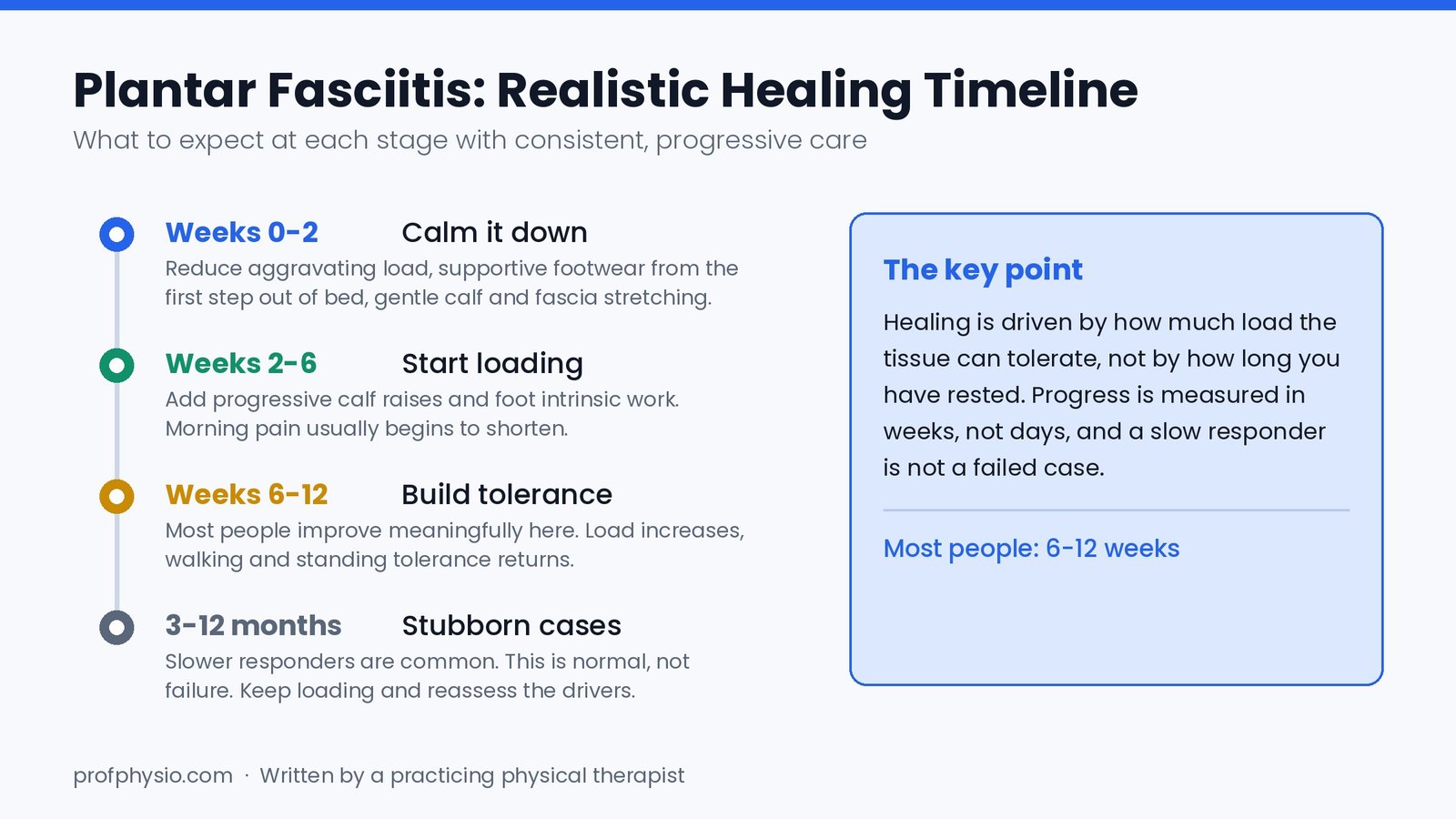
Studies revealed that about 90% of plantar fasciitis patients have a good prognosis and will improve from this condition within the first 6-12 months with conservative treatments.
The rest percentage of about 10% may be resolved by minimally invasive surgical treatment options like Tenex procedure or plantar fasciotomy or by plantar fascia release surgery but after exhaustion of the other mentioned treatment options.
But those patients who want to gain the best result and prognosis for their condition they will follow a method with their doctor and physical therapist by combination of conservative treatments like taking medications in conjunction with physical therapy and wearing the suitable orthosis or splint to decrease the stress on plantar fascia as much as possible especially in the first 6 months of onset.
But in severe cases when that has severe pain, your doctor may recommend to use a corticosteroid injection in the first month of the beginning but not after that according to evidence.
After 6 to 12 months of start, if you still have moderate to severe pain that increases gradually with the time, and no response to the conservative treatment options, then your doctor may will take a final decision to do a minimal invasive treatment or surgical treatment which is in less than 10% of plantar fasciitis cases.
How Can You Prevent Plantar Fasciitis?
You have to know what are the risk factors related to your body and lifestyle. You have to take control of those factors which are controllable. Here I’ll give you some guidelines to prevent recurrence of plantar fasciitis symptoms:
- Lose weight.If your body mass index (BMI) > 25, that means you are located in one of 4 classifications of obesity. So, this is the red alert of gaining more weight, and you have to lose the extra pounds that make more stress on the plantar fascia.
- Avoid wearing high heeled or so flat shoes.
- Avoid prolonged periods of standing or walking for long distances. Divide any prolonged activity into small parts, even if that is the nature of your occupation. Take breaks every 20-30 minutes.
- Stop doing any vigorous exercise or stretches. Avoid running for prolonged periods at once or for very long distances.
- Wearing the suitable type of Orthotics or Splints to keep your feet and ankle in an excellent normal state to decrease the stress on the plantar fascia, by using:
1. Shoe inserts (Shoe insoles)
This type of orthotics provide support for the foot arches and keep it in the best position with the least stress on the plantar fascia.
2.Heel pads (heel cups). Also called heel cushions.
This type of orthotics works like support cushion to the heel and bottom of the foot to decrease the pressure, which is loaded on the heel during different activities during the day.
3.Night splints or braces.
This type of brace is used to keep the Achilles tendon and calf muscles in the best-sustained stretch position. You can use it during the night while you are sleeping until you gain the best result and improvement of plantar fasciitis symptoms.
4.Walking boot or cast.
It’s a type of orthotics that used to protect the foot and ankle joint during walking or standing. It’s maybe more suitable in case of injury or surgery. Still, it can be used for a temporary period in some instances of plantar fasciitis.
- Kinesiology taping (physio tape). It’s a type of stretchable medical tape can be used by your physical therapist to apply it on your foot or ankle to relieve pain and decrease the stress of the plantar fascia, as it provides excellent support for the foot arches during standing, walking, running or other types of sports.
- Follow the instructions related to lifestyle and occupation from your physical therapist. Your physical therapist has a good knowledge of plantar fasciitis condition and your symptoms and about the factors that can make it worse. Make sure that you follow these instructions provided by your physical therapist, which is very important in gaining of best treatment result.
- Follow the home exercises program from your physical therapist. Home exercises program that your physical therapist teaches you is the most crucial part of the conservative medical treatment that you should follow, which will give you an excellent long-term prognosis for your condition.
Your physical therapist will teach you how to do these exercises and when to do, sets, repetition, and hold time in each repetition. Stretching and strengthening and range of motion exercises will be the most critical exercises in your physical therapy treatment plan.
The Bottom Line on Plantar Fasciitis
In this article, we talked in details about all the aspects of plantar fasciitis condition to make your decision.
So after you completed reading this article, you can now make your decision about your treatment to get the best option for you.
Now it’s your turn to tell us what the treatment options you received, and that worked, and how did you deal with your case?
Let us know in the comments below.
Plantar Fasciitis FAQs
How long does plantar fasciitis take to heal?
Most people improve meaningfully within 6 to 12 weeks of consistent loading work, footwear changes, and activity modification. Stubborn cases can take 6 to 12 months. Slow progress is common and does not mean the plan is failing.
Should I rest or keep walking with plantar fasciitis?
Complete rest is one of the most common mistakes. It reduces pain briefly and leaves the tissue less tolerant to load. The better approach is to reduce the aggravating volume while keeping the foot working through controlled, progressive loading.
What is the fastest way to relieve plantar fasciitis pain?
For short term relief, combine calf and plantar fascia stretching, supportive footwear worn from the moment you get out of bed, and a temporary reduction in standing and running volume. These measures ease symptoms, but lasting change comes from progressive loading over weeks.
Does plantar fasciitis ever go away permanently?
Yes, for most people it resolves. It can return if the original drivers return, such as a sudden jump in training volume, prolonged standing on hard surfaces, unsupportive footwear, or weight gain. Maintaining calf and foot strength is the best protection.
Is walking barefoot bad for plantar fasciitis?
Barefoot walking on hard indoor floors tends to aggravate symptoms during the painful phase because the fascia has no support. Supportive footwear or a house shoe with arch support is usually the more comfortable choice until pain settles.
When should I see a doctor for heel pain?
Seek assessment if the pain wakes you at night, if you have numbness or tingling in the foot, if the heel is painful after a specific injury, or if nothing has changed after six consistent weeks of conservative care.
References
- Buchbinder, R 2018, ‘Patient education: Heel and foot pain (caused by plantar fasciitis) (Beyond the Basics)’, https://www.uptodate.com/contents/search. Accessed on 15 Aug. 2019
- STEPHEN L. BARRETT, D.P.M., and ROBERT O’MALLEY, D.P.M., and ROBERT CRAWFORD, 1999, ‘Plantar Fasciitis and Other Causes of Heel Pain’, the American Academy of Family Physicians, 15;59(8), pp. 2200-2206, Accessed 15 Aug. 2019
- Mohammad A. T., Mehdi M., Mohammad N. T., Babak S., 2012, ‘Plantar fasciitis’, US National Library of Medicine National Institutes of Health Top of Form Bottom of Form, 17(8), pp 799–804, Accessed on 15 Aug. 2019
- Goff JD, and Crawford R, 2011, ‘Diagnosis and treatment of plantar fasciitis’, US National Library of Medicine National Institutes of Health, 15;84(6), pp. 676-82, Accessed 16 Aug. 2019
- PRISCILLA TU, DO, and JEFFREY R. BYTOMSKI, DO, 2011, ‘Diagnosis of Heel Pain’, the American Academy of Family Physicians, 15;84(8), pp. 909-916, Accessed 16 Aug. 2019
- Liselotte Hansen, Thøger Persson Krogh, Torkell Ellingsen, Lars Bolvig, and Ulrich Fredberg, 2018, ‘Long-Term Prognosis of Plantar Fasciitis: A 5- to 15-Year Follow-up Study of 174 Patients With Ultrasound Examination’, 6(3): 2325967118757983, Accessed 16 Aug. 2019
- Díaz López AM, Guzmán Carrasco P., 2014, ‘[Effectiveness of different physical therapy in conservative treatment of plantar fasciitis: a systematic review]’, 88(1), pp. 157-78, Accessed 12 Aug. 2019
- Al-Boloushi Z, López-Royo MP, Arian M, Gómez-Trullén EM, Herrero P, 2019, ‘Minimally invasive non-surgical management of plantar fasciitis: A systematic review‘, 23(1), pp. 122-137, Accessed 12 Aug. 2019
- Júlia Maria D’Andréa Greve, Marcus Vinicius Grecco, and Paulo Roberto Santos-Silva, 2009, ‘Comparison of Radial Shockwaves and Conventional Physiotherapy for Treating Plantar Fasciitis‘, 64(2), pp. 97–103, Accessed 12 Aug. 2019
- Sun J1, Gao F, Wang Y, Sun W, Jiang B, Li Z., 2017, ‘Extracorporeal shock wave therapy is effective in treating chronic plantar fasciitis: A meta-analysis of RCTs’, 96(15): e6621, Accessed 12 Aug. 2019
- Opeyemi O Babatunde, Amardeep Legha, Chris Littlewood, Linda S Chesterton, Martin J Thomas, Hylton B Menz, Danielle van der Windt, Edward Roddy, 2018, ‘Comparative effectiveness of treatment options for plantar heel pain: a systematic review with network meta-analysis‘, 53(3), Accessed 12 Aug. 2019
- Alshami AM, Souvlis T, Coppieters MW, 2008, ‘A review of plantar heel pain of neural origin: differential diagnosis and management‘, 13(2), pp 103-11, Accessed 21 Aug. 2019
- Monto RR, 2013, ‘Platelet-rich plasma and plantar fasciitis’, 21 (4), pp 220-4, Accessed 21 Aug. 2019
- Lareau CR, Sawyer GA, Wang JH, DiGiovanni CW, 2014, ‘Plantar and medial heel pain: diagnosis and management‘, 22 (6), pp 372-80, Accessed 21 Aug. 2019
- Thiel M, 2001, ‘Application of shock waves in medicine’, 387:18-21, Accessed 23 Aug. 2019