What is Cobra Stretch Exercise?
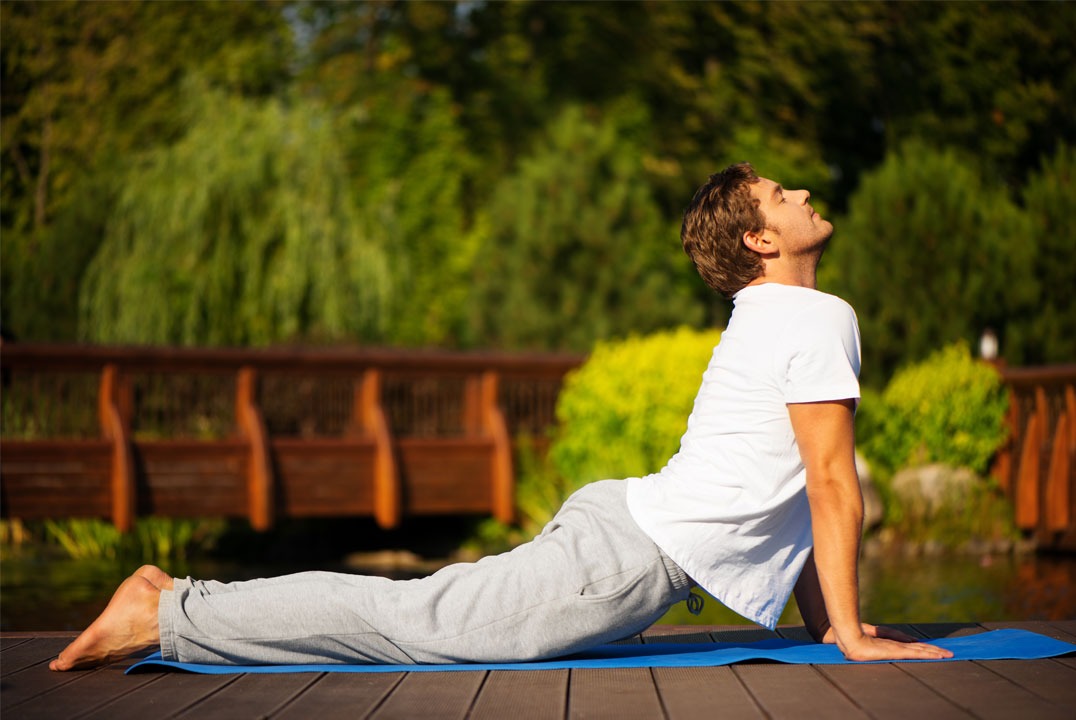
It’s a modern yoga exercise (a reclining back-bending asana). but in physiotherapy, we called it Mackenzie exercises. This name is taken from the Sanskrit words भुजङ्ग bhujaṅga or snake Cobra and it’s called Cobra pose which mean the cobra posture when it’s ready to attack.
How to do Cobra stretch correctly?
There is two types as a sequence to do cobra stretch exercise as explained in the video below:
- Half cobra stretch: for beginners and low flexibility people.
- Full cobra stretch: advanced version of cobra for good flexibility people.
You can do this yoga exercise on a sports mattress, or on a thick rug. Start with laying yourself in a prone position (on your stomach).
Half cobra stretch, follow these steps :
- Place your hands on the ground beneath and at the level of both shoulders, with both elbows bended 90 degrees.
- Keep your both legs contracted firmly to the ground, apart, plantarflexed and it’s backside touching the ground.
- Contract and hold your abdominal muscles during the exercise.
- Keep raising your back until you reach the full stretch of your spine as much as you can, keeping 90 degrees elbow flexion, while you press the shoulder blades down.
- Hold for 30 seconds then repeat 3 to 5 times.
Full cobra stretch, follow these steps :
- Follow the same steps of half cobra stretch above.
- Then straighten your elbows gradually while you raise your back, but keep your lower back and pelvis and hip muscle relaxed.
- Keep raising your back until you reach the full extension of both elbows as much as you can until reach the full stretch of the spine you can tolerate.
- While you raise your shoulders, keep your concentration on lower and middle back and press your shoulder blades into your upper back.
- Hold your head at upright and the gaze forward during doing the exercise.
But for those who are doing cobra stretch for the first time (beginners) or having neck pain, they should keep their head leaning forward a little bit and the gaze a little bit to the ground.
But for those with more flexibility can bring their gaze to the sky.
- At the top hold your back stretched for 30 seconds or count to 30.
- Then lower your back down slowly while you exhale your breath out.
- Repeat stretch for 3 to 5 times at each round, and from 1 to 2 times a day.
Precautions with Cobra stretch exercise
- During raising your back at initial take deep breath smoothly and slowly until you reach the top of full stretching.
- Avoid overstretch or overextend your spine especially if you do the full cobra stretch for the first time.
- For those people who are sedentary or have no flexibility of there spine, they should start cobra stretch gradually with increasing range and repetitions each day until they achieve the full cobra exercise.
Contraindications of cobra stretch exercise
There are some contraindications I want you to take in your considerations, and some of these contraindications you should ask your doctor before you are doing this exercise:
- If you are pregnant, cobra stretch exercise is not for you.
- If you have acute back pain, or recent strains or sprains.
- People have recent surgeries or other conditions of the back or abdomen.
- People who have wrist, elbow or shoulder conditions like for example carpal tunnel syndrome which affecting the wrist joint.
- Spine diseases like osteoporosis especially in old age people.
- Fractures of the spine or upper limbs joints.
- In spine conditions like spinal stenosis or spondylolisthesis, broad spread lumber disc cobra stretch is very dangerous to do.
- Spinal deformities like moderate to severe scoliosis and kyphosis or kyphoscoliosis.
- Other internal diseases like certain heart problems.
Cobra Stretch Exercise Physio Benefits –Immediately
- Strengthening of lower back muscles.
- Treatment of lower back conditions like lumbar disc herniation or bulge and sciatica.
- Increases the flexibility of the spine.
- Maintaining the normal curvatures of the lumbar and cervical spine.
- Stretching of the chest and anterior shoulder muscles which can enhancing breathing in asthma patients.
- Stimulate the internal organs of the abdomen which enhancing digestion.
- An energizing backbend, Cobra reduces stress and fatigue.
Cobra Stretch Health Benefits
- Very effective to decrease symptoms of low back pain like certain cases of lumbar disc and sciatica conditions.
- Decrease muscle spasm and stiffness of the lower back.
- Help in postural training for those people who sit in front of the office, computer or driving for long periods.
- Preventing low back pain and keep your back muscles flexible and strong.
- Enhancing performing daily activity livings and mobility.
- Enhancing your lifestyle performance.
Does Cobra Stretch Exercise Makes Harm on Your Spine?
Although yoga in general is relatively safe for low back pain, it’s not a risk-free form of exercise. Sensible precautions can usefully be taken, not just regarding the spine but for the whole body.
A systematic review study in 2013 about the use of yoga for low back pain found strong evidence for short and long-term effects on spine pain, and moderate evidence for long-term benefit in back-specific disability, with no serious adverse events.
That indicates that each person has his own condition and must, when practicing yoga exercises, especially in cobra stretch exercise, take special precautions, as well as consult a physician or physiotherapist to avoid any possible harm on your body.
References:
- Sjoman, Norman E.(1999) [1996]. The Yoga Tradition of the Mysore Palace (2nd ed.). Abhinav Publications. p. 71.
- Newcombe 2019. Chapter “Yoga as Therapy”. pp. 203-227
- Cramer, Holger; Lauche, Romy; Haller, Heidemarie; Dobos, Gustav (2013). “A Systematic Review and Meta-analysis of Yoga for Low Back Pain”. The Clinical Journal of Pain. 29(5): 450–460.
- Yoga for Chronic Pain, Part I, By Timothy McCall, M.D. www.yogajournal.com.Retrieved on 17 Jan 2020.
- Ross A, Thomas S. ‘The health benefits of yoga and exercise: a review of comparison studies’. J Altern Complement Med. 2010;16(1):3–12. doi:10.1089/acm.2009.0044
- Govindaraj R, Karmani S, Varambally S, Gangadhar BN. ‘Yoga and physical exercise – a review and comparison’. Int Rev Psychiatry. 2016 28(3):242–253.